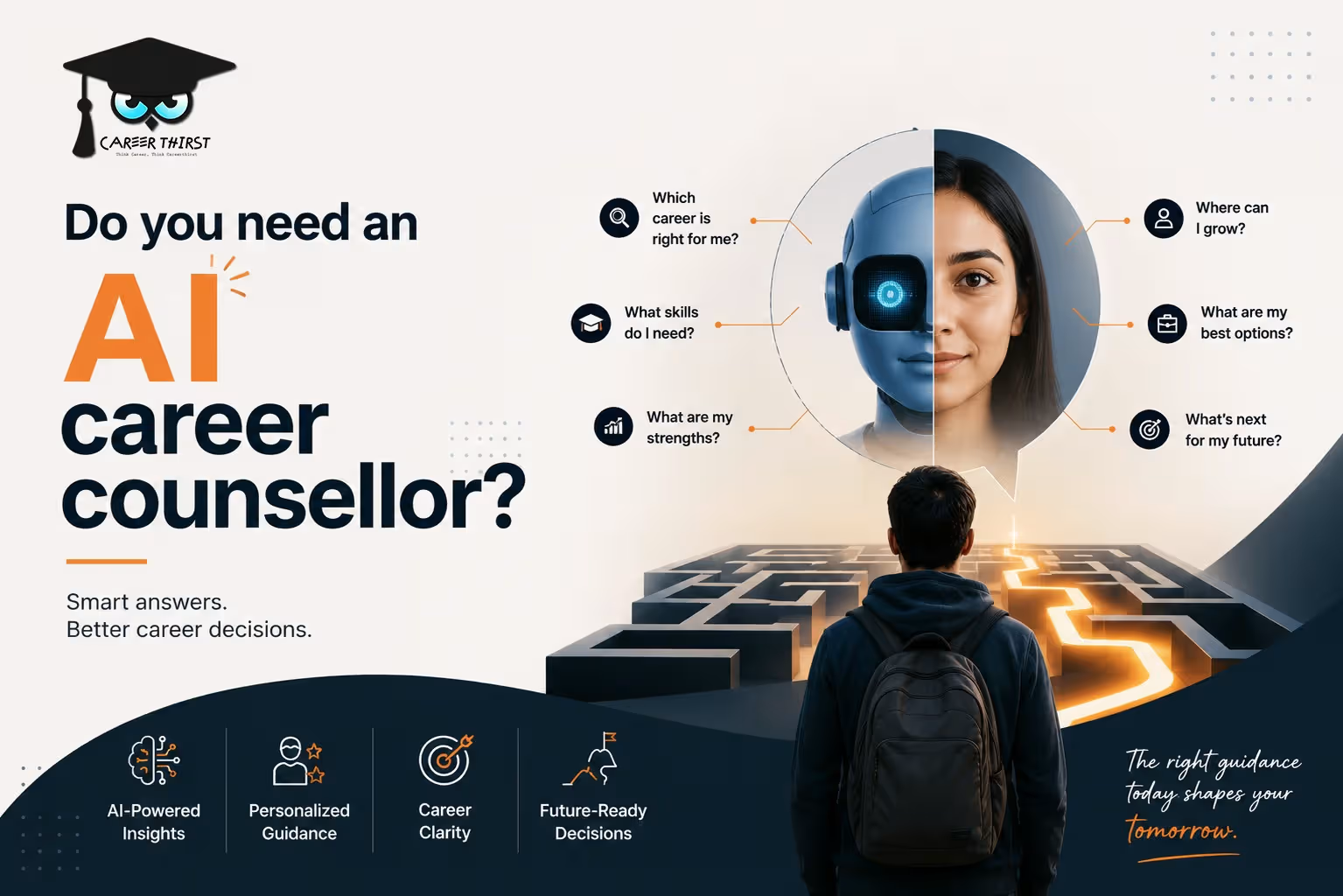
Feeling stuck about your next career move is common, but staying stuck isn’t necessary anymore. An AI career counsellor can analyze your skills, goals, and the job market in minutes, something that used to take weeks of research or expensive coaching sessions. This guide walks through the clearest signs that you need one, the real benefits it offers, and exactly how the technology works behind the scenes.
What Is an AI Career Counsellor?
An AI career counsellor is a digital tool that uses machine learning to assess your skills, interests, and goals, then recommends career paths, courses, or job matches. It works like a 24/7 advisor that studies market data instead of relying on personal opinion alone. Unlike a search engine, it personalizes every answer to your specific profile and history.
Most tools in this space fall into two categories. Some are simple AI career guidance chatbots that answer direct questions, while others are full platforms offering resume scoring, mock interviews, and skill-gap tracking. Both types pull from labor market databases, so their suggestions reflect actual hiring trends rather than guesswork.
Top Signs You Need an AI Career Counsellor
Certain patterns in your career life signal that outside guidance, especially fast and data-backed guidance, would help. Here’s how to recognize them.
You Feel Directionless After Graduation or a Layoff
A sudden gap in direction is one of the clearest signals. Fresh graduates often don’t know which industries value their degree, and recently laid-off professionals face a similar blank slate. An AI career counsellor can quickly map your existing skills to roles you may not have considered.
You Keep Applying but Never Hear Back
Silence after dozens of applications usually points to a mismatch between your resume and what employers actually search for. AI career guidance tools scan job descriptions and highlight the exact keywords and skills missing from your profile. That single fix often changes response rates within weeks.
You Don’t Know Which Skills Are Worth Learning
The job market shifts fast, and guessing which certification or skill to learn next wastes time and money. An AI-based career test evaluates. current demand data and shows which skills carry the highest return for your specific field. This removes the guesswork that traditional advice often leaves behind.
You Can’t Afford Traditional Career Coaching
Human career coaches typically charge between seventy and three hundred dollars per session, and many professionals simply can’t justify that cost. A free AI career counsellor delivers similar research and guidance at no cost or a small monthly fee. It won’t replace deep emotional coaching, but it covers the research-heavy parts of career planning well.
You Want Answers Outside Business Hours
Career anxiety rarely waits for office hours. When a decision needs to be made at midnight or during a weekend, an AI career counselling tool responds instantly. That immediacy matters more than people expect, since momentum on a decision often fades by the next morning.
How an AI Career Counsellor Actually Works
Understanding the process behind the recommendations builds trust in the results.
Step One: Profile and Data Collection
The tool starts by collecting details about you, usually through your resume, LinkedIn profile, or a short questionnaire. It captures your skills, work history, and stated goals. Some platforms also ask about preferences like risk tolerance or desired work-life balance.
Step Two: Market Pattern Matching
Next, the system compares your profile against thousands of job postings, salary reports, and hiring trends. According to a 2025 LinkedIn Workforce report, job seekers using AI-assisted tools found new roles roughly 30 percent faster than those relying on manual search alone. This stage is where AI genuinely outperforms manual research, since no human could scan that much data in seconds.
Step Three: Personalized Recommendations
Finally, the platform generates a tailored output. This might be a list of matching job titles, a suggested learning path, or specific resume edits. The strongest tools explain their reasoning instead of issuing an unexplained verdict, which makes the advice easier to act on with confidence.
Key Benefits of Using an AI Career Counsellor
The advantages go beyond simple convenience, and they compound when used consistently.
Speed and Availability
Traditional coaching requires scheduling, waiting, and travel in some cases. An AI career counsellor removes all of that friction and delivers answers the moment you ask. For anyone juggling a full-time job while job hunting, that speed alone can be the deciding factor.
Lower Cost Without Losing Depth
Because these tools run on automated data pipelines, they can offer detailed analysis at a fraction of human coaching prices. Many platforms provide a solid free tier before asking for payment. This makes quality career guidance accessible to students and early-career professionals who need it most.
Consistent, Bias-Aware Recommendations
Human advice can vary based on a coach’s personal experience or blind spots. A well-built AI model draws from a far broader dataset, reducing the risk of narrow suggestions based on one person’s limited exposure. That said, no dataset is perfectly neutral, so cross-checking major decisions still matters.
AI Career Counsellor vs Human Career Coach
Choosing between the two often depends on budget, urgency, and the emotional weight of your situation.
Factor | AI Career Counsellor | Human Career Coach |
Cost | Free to low monthly fee | $70–$300 per session |
Response time | Instant, 24/7 | Scheduled appointments |
Emotional support | Limited | Strong |
Market data depth | Very strong | Varies by coach |
Accountability | Weak without reminders | Strong, built-in check-ins |
Best use case | Research, resume fixes, quick decisions | Confidence issues, major transitions |
Many professionals now combine both. They use an AI career guidance tool for research and shortlisting, then bring the final decision to a human coach for perspective and human coach for perspective and encouragement.
Where AI Career Guidance Still Falls Short
No tool solves everything, and knowing the limits keeps expectations realistic. Emotional nuance remains the biggest gap, since an algorithm cannot replace genuine empathy during a stressful transition. Context can also be missing, since an AI tool won’t know that a specific company just had layoffs or a difficult culture unless that data was recently indexed.
Bias in training data is another factor worth watching. If historical hiring patterns favored certain industries or backgrounds, recommendations may quietly reflect that skew. Treat every AI suggestion as a strong starting point, not a final verdict, and verify anything that affects a major life decision.
Final Thoughts
An AI career counsellor won’t replace human judgment entirely, but it removes the slowest, most repetitive parts of career planning. If you recognize even one of the signs covered here, testing a free tool costs nothing and could save weeks of uncertainty. Pair it with a human coach for bigger transitions, and you get the best of both speed and empathy. Explore our comparison guide on top AI career tools for 2026, and check our resume optimization checklist for a related next step.
What is an AI Career Counsellor?
An AI career counsellor is a software tool that uses machine learning to assess your skills, interests, and work history, then recommends suitable career paths or job matches. It replaces or supplements traditional one-on-one advising with instant, data-backed suggestions. Most platforms combine resume analysis, market trend data, and personality or interest questionnaires to personalize results. Unlike a search engine, it tailors every recommendation to your specific profile rather than giving generic advice.
How does an AI Career Counsellor work?
The tool first collects data about you through your resume, LinkedIn profile, or a short quiz covering your skills and goals. It then compares this profile against large datasets of job postings, salary trends, and hiring patterns using machine learning models. Based on that comparison, it generates personalized suggestions like job titles, courses, or resume edits. The best tools also explain their reasoning, so you understand why a recommendation was made rather than just receiving a list.
Why should I use an AI Career Counsellor?
An AI career counsellor gives you instant, round-the-clock access to career guidance without the cost or wait time of traditional coaching. It’s especially useful when you feel stuck, are switching industries, or need quick feedback on your resume. Because it draws on wide market data, it often catches trends or opportunities a single human advisor might miss. It works best as a starting point for research, with deeper emotional or strategic decisions still benefiting from human input.
Where can I find an AI Career Counsellor?
Several platforms now offer AI-driven career guidance, including LinkedIn’s AI career tools, dedicated apps like Careervira and Yoodli, and general AI assistants like Claude or ChatGPT used for career coaching prompts. Many universities and job portals have also started embedding AI career quizzes directly into their career services pages. A quick search for “AI career counsellor” or “AI career guidance tool” surfaces most active platforms. Free tiers are common, so it’s worth testing two or three before committing to a paid plan.
Why is AI being used in career counselling?
AI is being used because it can process far more labor market data than any single human advisor could analyze manually. It removes scheduling barriers, since users can get guidance instantly instead of booking appointments weeks in advance. Career counselling has also become more complex as industries shift quickly, and AI helps track those changes in near real time. Cost is another major driver, since AI tools make quality career guidance accessible to people who can’t afford traditional coaching fees.
What are the key benefits of using an AI career counsellor compared to a human one?
AI career counsellors are faster, cheaper, and available at any hour, which matters most during time-sensitive job searches. They also draw from much larger datasets, reducing the risk of narrow advice based on one person’s limited industry exposure. Human coaches, by contrast, offer stronger emotional support and can read subtle cues an algorithm misses. Many professionals now use both together, treating AI as the research layer and human coaching as the confidence and accountability layer.
What kind of data does an AI Career Counsellor use to provide recommendations?
Most AI career counselors analyze your resume, LinkedIn profile, and any quiz answers about your interests, values, and work style. They cross-reference this with external data like job postings, salary reports, and hiring trends across industries. Some advanced tools also factor in regional job demand and require certifications for specific roles. The more detailed and honest your input, the more accurate and specific the resulting recommendations tend to be.
Are there any limitations or potential drawbacks to relying on an AI for career advice?
Yes, AI career tools can miss emotional context, like burnout, workplace conflict, or personal confidence issues that a human coach would naturally pick up on. Bias in training data is another concern, since historical hiring patterns may unintentionally skew certain recommendations. AI also can’t always account for very recent, unindexed events like a company’s sudden layoffs or reputation changes. It’s best treated as a strong starting point rather than the final word on a major career decision.
Can an AI Career Counsellor predict future job market trends?
AI career tools can identify emerging patterns by analyzing large volumes of job postings, hiring velocity, and skill demand over time. This allows them to flag growing fields, like AI-related roles or green energy jobs, earlier than traditional reports often do. However, predictions are based on historical and current data, so sudden economic shifts or unforeseen events can still catch these models off guard. Treat trend predictions as informed estimates rather than guarantees when planning a long-term career move.
How does an AI career counsellor assess my skills and interests to suggest suitable career paths?
Most tools start with a structured questionnaire covering your technical skills, soft skills, values, and preferred work environment. Some also scan your resume or LinkedIn profile to extract skills you may not have listed manually. The system then matches this profile against job requirement data to identify roles with the highest compatibility score. A few advanced platforms refine suggestions further based on your feedback, learning your preferences the more you interact with the tool.