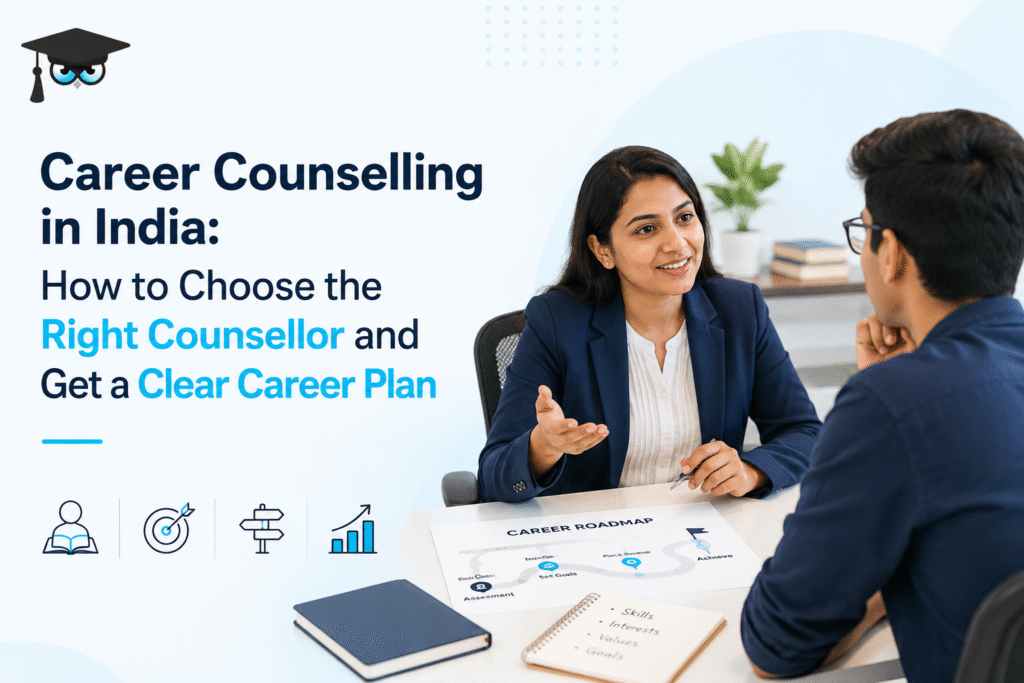
Career counselling in India has moved from a nice extra to a decision most families now take seriously. A student in Class 10 faces stream selection with dozens of options behind each stream. A Class 12 student faces CUET, JEE, NEET, CLAT, design entrances and a long list of private universities, all with different fees and outcomes. A graduate faces a job market where the same degree can lead to very different salaries depending on skills and direction. If you are reading this, you probably want one thing: a qualified person who can look at your profile and tell you what to do next. This guide explains what professional career counselling includes, how to separate genuine counsellors from sales calls, what it costs, and how to book a session that ends with a written plan instead of a vague conversation.
What Career Counselling in India Actually Includes
Many people assume career counselling means a one hour chat where someone suggests engineering or medicine. A proper session is structured and has three parts: assessment, a counselling conversation, and a roadmap with follow up. If a provider skips any of these, you are buying advice, not counselling.
Psychometric and aptitude assessment
The process starts with data about the student. Good counsellors use validated psychometric tools that measure interests, aptitude, personality and values. Interest inventories based on the Holland Codes model, aptitude tests covering numerical, verbal and logical reasoning, and personality questionnaires are common. These tools do not hand out a verdict. They give the counsellor a structured starting point so the conversation is built on evidence and not on the counsellor’s guess or the parent’s preference.
The quality of the report matters. A useful report explains what each score means in plain language, lists career clusters that fit the profile, and flags areas where the student’s interests and abilities do not match. A report that simply says “you are creative, choose design” is a template, not an assessment.
The one on one counselling session
The assessment report is only as useful as the conversation that follows. In a good session the counsellor reads the report with the student, asks about school subjects, marks, hobbies, family expectations and financial limits, and tests the results against reality. A student who scores high on investigative interests but has weak mathematics needs a different plan from one who scores high on both. A student whose family can fund only a government college needs a different shortlist from one with no budget constraint.
Parents are usually part of this stage, and they should be. Most career conflicts at home come from each side holding different information. A counsellor who explains the data to both the student and the parents often resolves in one hour what months of arguments could not.
A written roadmap and follow up
The last part is what most low quality providers skip. A roadmap should name the recommended streams or courses, the entrance exams to prepare for, the colleges to target in order of priority, the backup options, and the timeline for each step. It should also list the skills to build alongside academics. Follow up matters because plans change when board results arrive, when an entrance exam goes badly, or when a student’s interest shifts after a few months in a new stream. Ask any provider whether follow up sessions are included and for how long.
Who Needs Career Counselling for Students and When
Career counselling for students is useful at four points, and the earlier you act, the more options you keep open.
After Class 8 to 10: stream selection
This is the first real fork. Science, commerce and humanities each lead to different entrance exams and degrees, and switching later costs a year or more. Students who choose a stream because friends chose it or because of family pressure often lose confidence by Class 11. Counselling at this stage helps a student pick a stream that matches ability and interest, and it removes the myth that only science students have good careers. If you are at this stage, our guide to career options after 10th covers each path in detail.
Class 11 and 12: course and entrance exam planning
By Class 11 the question changes from which stream to which course, and the competition gets sharper. Students need to decide between engineering, medicine, law, design, management, humanities and newer fields like data science and economics, then plan exam preparation accordingly. This is also where wrong decisions get expensive, because coaching fees and dropped years add up. Our breakdown of career options after 12th and our guide on course selection help you prepare before the session so you can use the time to go deeper.
During graduation: skills and specialisation
Many graduates realise in the second or third year that their degree does not lead where they expected. Counselling at this stage focuses on electives, internships, certifications and the choice between a job, a master’s degree or a competitive exam. The aim is to close the gap between what the degree teaches and what employers hire for.
Working professionals: career change and growth
Professionals with a few years of experience also use counselling, mainly when considering a switch of industry, a management degree or a move abroad. The assessment is lighter and the conversation focuses on transferable skills, salary expectations and risk.
Why Demand for Career Counselling in India Keeps Rising
Three changes explain the growth. First, the National Education Policy 2020 introduced flexible subject combinations and multiple entry and exit points in higher education. This is good for students, but it also means more choices to evaluate. You can read the policy framework on the Ministry of Education website. Second, admission to central universities now runs through the Common University Entrance Test, conducted by the National Testing Agency, which changes how students prepare and which universities they can realistically target. Third, the range of careers has widened. Fields such as data analytics, UX design, sports management, digital marketing, cyber security and sustainability barely existed as degree options a decade ago, and school teachers and relatives rarely have first hand knowledge of them.
The government has recognised the need as well. The National Career Service portal run by the Ministry of Labour and Employment offers career counselling, job listings and assessment resources, and it is a useful free starting point. What it cannot do is replace a personalised conversation that accounts for your marks, budget, city, family situation and long term goals.
Career Counselling vs Advice From Family, Coaching Centres and Online Quizzes
Students already receive plenty of advice, so it is fair to ask what a professional adds. The difference is neutrality and method.
Family advice carries love and also bias. Parents tend to recommend what worked in their own generation or what they fear for their child. Coaching centres have a financial interest in enrolling you for a particular exam. Some college admission agents earn commission from the institutions they recommend. Free online quizzes give a result in five minutes, but they use short, unvalidated questionnaires and cannot account for your circumstances.
A qualified career counsellor works for the student. The recommendation comes from assessment data and an honest conversation, and it should include options that cost the counsellor nothing and may even reduce their earnings, such as a government college or a skill route that skips a degree. That independence is the single most important quality to check when you evaluate providers.
How to Find the Top Career Counsellors in India
Searches for the top career counsellors in India return long lists, and most of those lists are paid placements. Rankings tell you very little. What you need is a set of criteria you can check yourself in a ten minute phone call.
Check qualifications and training
Look for counsellors with a postgraduate degree in psychology, counselling or education, or with a recognised certification in career guidance. Ask how many years they have worked specifically with students of your age group, because guiding a Class 10 student and guiding a final year MBA student require different skills. Experience with the Indian education system, including boards, entrance exams and admission rules, matters more than international credentials alone.
Ask which assessments they use
A reliable counsellor can name the tools in their process and explain why they chose them. If the answer is vague, or if the provider says they “just know” from talking to the student, move on. Ask to see a sample report. A good sample shows scores, interpretation and a clear link between the results and the recommendations.
Confirm they are independent of colleges
Ask directly whether the organisation earns money from colleges, coaching institutes or study abroad consultancies. A provider can run both businesses honestly, but you should know about it before you trust the recommendation. A trustworthy counsellor will answer plainly and will be comfortable naming options outside any partner network.
Look for transparent pricing and deliverables
Before you pay, you should know the exact fee, the number of sessions, whether the assessment is included, whether parents can attend, how long the report takes, and whether follow up is part of the price. Packages that hide the details until after payment are a warning sign.
Read reviews with care
Google reviews, testimonials and case studies help, but read them for specifics. A review that describes the student’s situation and what changed afterwards is more reliable than five stars with no text. Ask the provider if you can speak with a parent who used the service, and notice how they respond.
Red Flags to Avoid
Some patterns show up repeatedly in poor quality counselling. A provider that promises a 100 percent successful career or guaranteed admission is not being honest, because no counsellor controls admission outcomes. A counsellor who recommends a specific college in the first ten minutes, before any assessment, is selling. Pressure to pay today for a discount that expires tonight is a sales tactic and not a counselling practice. A report that looks identical for every student, with only the name changed, is a template. If you notice two or more of these, walk away.
Career Counselling Cost in India
Fees vary widely by city, the counsellor’s experience, and the depth of the programme. As a rough guide, a single session with a basic assessment can start in the low thousands of rupees, while a full programme with comprehensive assessment, multiple sessions, a detailed roadmap and follow up can cost several thousand more. Premium programmes with extended mentoring cost more again. Treat these as indicative ranges and always ask for a written quote.
The better way to judge the price is by what it prevents. A wrong course choice can cost one or two years and several lakh rupees in fees, coaching and living expenses. A clear plan that avoids one such mistake pays for itself many times over. That said, expensive does not mean better. Compare deliverables, not just prices, and pick the provider whose process you understand.
Online vs Offline Career Counselling
Both formats work, and the right choice depends on your situation. Online counselling gives students in smaller towns access to experienced counsellors who may be based in Delhi, Noida, Mumbai or Bangalore. Assessments are taken on a laptop or phone, and sessions happen over video. For most students this is equally effective and much more convenient. Offline sessions suit students who prefer face to face conversation, families who want to attend together, and cases where the counsellor wants to observe the student in person. Whichever you choose, check that the assessment is the same and that the session length is not shortened for online bookings.
What a Good Counselling Process Looks Like, Step by Step
Knowing the sequence helps you judge any provider, including us. A well run programme usually begins with a short intake call where the counsellor learns your class, marks, interests and concerns. You then take the assessment, which normally needs forty to ninety minutes. The counsellor studies the report before the session, so the meeting is spent on interpretation and not on reading scores aloud. In the session, the student and parents discuss the findings, test them against marks, budget and location, and narrow the choices to a small shortlist. Within a few days you receive the written roadmap with courses, exams, colleges and a timeline. A follow up session after board results or entrance exam outcomes lets you adjust the plan.
At CareerThirst, we built our career counselling services around this evidence first approach, and we encourage families to compare our process with any other provider before deciding. Students from across India, including those outside metro cities, can book a session online or visit us in Noida.
How to Prepare for Your Career Counselling Session
Preparation changes the quality of the outcome. Gather the last two years of report cards, any certificates or competition results, and a list of subjects you enjoy and dislike. Write down two or three careers you have already considered and the reasons. Parents should note their budget range, any location limits and their honest concerns. Come ready to answer questions openly, because the assessment and the counsellor can only help if the inputs are truthful. Students who answer the assessment according to what they think parents want end up with a plan that does not fit them.
It also helps to browse a few sources beforehand. The NIRF rankings show how Indian institutions compare on teaching, research and outcomes, and the AICTE website lists approved technical and management institutions. Verifying that a college is approved before you shortlist it saves a lot of trouble later. The University Grants Commission publishes lists of recognised universities and warns about fake ones, which is worth checking for any private institution you consider.
What You Should Walk Away With
After a good counselling engagement, you should have four things. First, a clear primary recommendation with reasons you understand. Second, two backup options in case the first path does not work out. Third, a timeline covering exams, applications and skill building for the next twelve to twenty-four months. Fourth, confidence that the decision is yours and not the counsellor’s. If you finish a programme without these, ask for a revised report. A reputable provider will agree.
Book Career Counselling in India With CareerThirst
If you are ready to move from confusion to a plan, the next step is a conversation. Share your class, your current concerns and what you want to decide, and our counsellors will explain how the process works for your situation before you commit to anything.
You can reach CareerThirst at Ocean Complex, Sector 18, Noida, Pin 201301, call us on +91 8299251579, or write to Info@careerthirst.com. You can also use the contact page to request a callback.
Frequently Asked Questions About Career Counselling in India
What is career counselling and how does it help students?
Career counselling is a structured process in which a trained counsellor assesses a student’s interests, aptitude, personality and circumstances, then recommends suitable courses and careers with a roadmap. It helps students choose a stream or degree based on evidence, which lowers the chance of dropping out, switching courses or studying something that does not match their strengths.
At what age or class should a student start career counselling?
The most common starting points are Class 9 or 10 for stream selection and Class 11 or 12 for course and entrance exam planning. Starting earlier gives more time to build relevant skills, but counselling is useful at any stage, including graduation and early career.
How much does career counselling cost in India?
Costs depend on the provider, the assessment used and the number of sessions. Basic sessions are priced lower and comprehensive programmes with assessments, a roadmap and follow up are priced higher. Ask for a written quote that lists exactly what is included before you pay.
How do I know if a career counsellor is genuine?
Check their qualifications, ask which assessments they use and request a sample report. Confirm whether they receive commission from colleges, and avoid anyone who guarantees admission or results. Genuine counsellors explain their method, share pricing clearly and give you time to decide.
Is online career counselling as effective as in person sessions?
For most students, yes. The assessment is usually taken online in both formats, and a video session allows the same discussion. Online counselling also gives students in smaller cities access to experienced counsellors. Choose offline only if you or your family strongly prefer meeting face to face.
Can career counselling help after poor board results or a failed entrance exam?
Yes. This is one of the most valuable times to seek guidance. A counsellor can help you identify alternative courses, second attempt strategies, lateral entry routes and skill based paths so that one result does not decide your future.
Do parents need to attend the counselling session?
It is recommended, especially for school students. Parents bring information about budget, location and family expectations that affects the plan, and hearing the assessment results directly from the counsellor reduces disagreements at home.
How long does a career counselling programme take?
A typical programme runs from one to three weeks, covering the intake, assessment, counselling session and delivery of the roadmap. Follow up sessions may be scheduled later, after exam results or admissions.