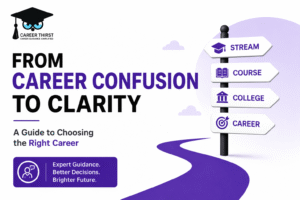
Choosing a career is not one decision. For Indian students, it is a series of decisions that usually starts with choosing a stream after Class 10 and continues through course selection, entrance exams, college selection, and admission.
The confusion usually starts with simple questions.
Should I choose Science, Commerce, or Humanities after Class 10? Which course should I pursue after Class 12? Is the career I like actually suitable for me? Which entrance exam do I need to take? Which college should I apply to? Should I follow my parents’ advice or choose something I personally enjoy?
These questions are difficult because there is no single career that is right for every student.
The right career decision depends on the student’s academic background, interests, strengths, goals, preferred type of work, education options, and the opportunities available in that field.
This guide answers some of the most common questions students and parents have when trying to move from career confusion to a clear education and career plan.
How Do I Choose the Right Career?
The right career should not be selected only on the basis of salary, popularity, marks, or what other students are doing.
Start by understanding your academic strengths and the subjects you enjoy. Then identify the type of work that interests you and explore careers connected to those areas.
Once you have a few possible career options, research the courses required for those careers, the entrance exams involved, colleges offering those courses, the cost of education, and the opportunities available after graduation.
For example, a student interested in business can explore management, commerce, economics, finance, entrepreneurship, and related fields instead of limiting the choice to one profession.
The goal is not to find one perfect career immediately. The goal is to narrow down realistic options and understand what each option involves before making a decision.
Which Career Is Best for Me After Class 10?
There is no single “best career” after Class 10.
Class 10 is mainly the stage where students begin choosing an academic direction. The Science, Commerce, and Humanities streams can lead to different courses and career pathways.
A student interested in engineering, medicine, research, technology, or mathematics may explore Science-related pathways. A student interested in accounting, finance, business, economics, or management may consider Commerce. A student interested in law, psychology, social sciences, media, design, public policy, and several other areas may explore Humanities.
However, the stream should not be chosen simply because one stream is considered more prestigious than another.
The better question is: Which stream keeps the right academic and career options open for me based on my interests and future plans?
Which Stream Should I Choose After Class 10?
The answer depends on what you want to study later and which subjects you are comfortable with.
If you are considering engineering or many science-based courses, you need to understand the subject requirements associated with those pathways. If you are interested in business, finance, accounting, or economics, Commerce may be relevant. If your interests are connected to law, psychology, social sciences, media, design, or other humanities-related areas, Humanities can provide relevant academic pathways.
Students should also check the eligibility requirements of the careers and courses they are considering before selecting their Class 11 subjects.
This is important because some undergraduate courses and entrance examinations have specific subject requirements.
Is Science the Best Stream After Class 10?
Science is not automatically the best stream for every student.
Science can provide access to several academic and career pathways, including engineering, medicine, research, technology, mathematics, and other science-related fields. But choosing Science only because it is considered a “safe” or “better” option can create problems if the student has little interest in the subjects.
A student should consider whether they are comfortable with the subjects involved and whether the future courses they are considering require a Science background.
The right stream is the one that supports the student’s intended academic pathway rather than the one that is simply considered popular.
What Should I Do If I Have Good Marks but No Career Interest?
Good marks give you more academic options, but they do not automatically tell you which career to choose.
If you perform well academically but are unsure about your career, start by exploring your interests and the type of work you would like to do.
You can also use career assessments to understand areas that may match your interests, strengths, and preferences. These results can then be discussed with a career counsellor to explore suitable courses and career pathways.
You do not need to have your entire career decided at 15, 16, or 17. You need enough clarity to make your next academic decision responsibly.
How Do I Choose a Course After Class 12?
Choosing a course after Class 12 requires more research than simply searching for the most popular degree.
First, understand what the course actually teaches. Then check eligibility, admission requirements, entrance examinations, duration, fees, college options, internship opportunities, and possible career pathways after graduation.
For example, a student interested in business can compare BBA, B.Com, economics, and other management-related programmes. A student interested in computers can compare different technology and computer-related undergraduate programmes.
Two courses may appear similar but can have very different curricula and career outcomes.
Before applying, students should understand the complete education pathway rather than selecting a course based only on its name.
How Do I Choose the Right College?
The right college depends on the course you want to study and what you expect from your education.
Instead of asking only, “Which is the best college in India?”, ask a more useful question: “Which college is a good fit for my course, academic goals, budget, and future plans?”
Students should compare the course curriculum, eligibility requirements, admission process, fees, location, faculty, infrastructure, internships, placement support, and opportunities for higher education.
College rankings can be useful for comparison, but they should not be the only factor in the final decision.
A highly ranked college may not be the right choice if its course, fees, location, or admission requirements do not fit the student.
Which Entrance Exam Should I Prepare For?
The entrance exam depends on the course and college you want to enter.
Different programmes and universities can have different admission processes. Some courses may use national-level entrance examinations, while others may have university-specific or institution-specific admission routes.
Students should first shortlist the courses and colleges they are interested in and then check their current admission requirements.
This approach is better than preparing for an entrance exam without knowing which courses and colleges it will actually help you enter.
Students should also check official admission information because eligibility criteria, examination patterns, and admission procedures can change.
Should I Choose a Career Based on Salary?
Salary is an important part of career planning, but it should not be the only reason for choosing a profession.
A student may select a high-paying field without considering whether they are interested in the work or have the skills required for it.
When comparing careers, consider earning potential along with the education required, skills involved, work responsibilities, career growth, job opportunities, and your own interests.
The better question is not “Which career pays the most?”
It is “Which career can provide good opportunities while also matching my abilities and interests?”
What If I Like Two Completely Different Careers?
You do not always have to choose immediately between two interests.
First, understand both options properly.
Compare the courses required, entrance exams, academic subjects, college options, costs, work responsibilities, and future opportunities associated with each career.
Sometimes two interests can also connect.
For example, someone interested in both technology and business could explore areas such as technology management, product management, business analytics, or entrepreneurship.
Career counselling can be useful in this situation because it can help students compare options based on their individual profile rather than choosing one simply because it is more popular.
Can Career Counselling Help If I Have No Idea What I Want to Do?
Yes. Career counselling is not only for students who have already decided on a career.
It can be particularly useful for students who have no clear direction.
A career counsellor can begin by understanding the student’s academic background, interests, strengths, preferences, and concerns. From there, different career areas can be explored and connected with suitable courses and education pathways.
The purpose is not to tell a student, “This is your career.”
The purpose is to help the student understand why certain options may or may not be suitable and what they can do next.
Are Career Assessments Enough to Choose a Career?
No. A career assessment should be considered a starting point, not the final decision.
An assessment may provide information about interests, strengths, personality preferences, or possible career areas. But the result needs context.
A student’s academic performance, personal goals, financial considerations, preferred education pathway, and understanding of the actual profession also matter.
For this reason, assessment results are more useful when discussed as part of a broader career counselling process.
What If My Parents Want Me to Choose a Different Career?
This situation is common.
Parents usually want their children to have a stable and successful future, but students may have different interests or may want to explore careers that their parents do not know much about.
Instead of treating the discussion as a conflict, start with information.
Research the course, eligibility, colleges, fees, entrance requirements, career opportunities, and future growth of the career you are interested in. Then discuss the information with your parents.
A career counsellor can also help students and parents understand different options objectively.
The final decision should consider the student’s abilities and goals while also taking practical factors into account.
How Can I Know If a Career Is Right for Me?
You cannot know everything about a career before entering the field, but you can research enough to make a more informed decision.
Start by understanding what professionals in that field actually do. Find out what subjects and skills are required, which courses lead to the profession, what the work environment is like, and what opportunities are available.
You should also consider whether the work matches your interests and strengths.
For example, liking computers does not automatically mean that every technology career will suit you. You may prefer programming, design, data, cybersecurity, product management, or another area.
Understanding the difference between an industry and a specific career role can help you make a better decision.
When Should I Take Career Counselling?
There is no need to wait until you are completely lost.
Class 9 and 10 students can seek guidance when they are beginning to think about streams and future career options. Class 11 and 12 students may need help with course selection, entrance exams, and college planning.
Career counselling can also help students who already have a career in mind but want to check whether their academic plan and college choices support that goal.
The earlier students understand the requirements of different pathways, the more time they have to prepare.
What Does Career Thirst Help Students With?
Career Thirst helps students navigate the decisions that come between school and higher education.
The process can begin with career counselling and assessment, where students can explore their interests, strengths, and possible career directions.
Students can then receive guidance on stream and course selection, college discovery, entrance exams, applications, and scholarship opportunities.
This is particularly useful because career decisions are connected.
Choosing a stream affects the courses a student can consider. Course selection affects college options. College selection is connected to admission requirements and entrance exams.
Career Thirst brings these different parts of the education journey together so students and parents can make decisions with a clearer understanding of the next step.
What Is the Best Way to Move From Career Confusion to Clarity?
The best approach is to stop trying to answer every career question at once.
Start with the decision that is directly in front of you.
If you are in Class 10, focus on understanding your stream options and the courses that may follow them.
If you are in Class 12, focus on identifying suitable courses, checking entrance exams, and shortlisting colleges.
If you already know your course, focus on comparing colleges, admission requirements, fees, scholarships, and future opportunities.
Career clarity does not mean knowing exactly where you will be ten years from now.
It means knowing what you should do next and why you are doing it.
Final Thoughts
The right career is not necessarily the most popular career, the highest-paying career, or the career your friend has chosen.
It is a career path that makes sense when your interests, abilities, academic background, goals, and practical circumstances are considered together.
For Indian students, that decision often begins with stream selection and continues through course selection, entrance exams, college discovery, and admission.
You do not have to make all these decisions alone.
Career Thirst provides career counselling and guidance to help students understand their options at each stage of their education journey.
If you are confused about your stream, course, career, entrance exam, or college, the first step is not to make a rushed decision.
The first step is to understand your options.
Start Your Career Journey With Career Thirst
Career Thirst helps students explore career options, choose suitable courses and colleges, understand admission pathways, and move forward with greater clarity.