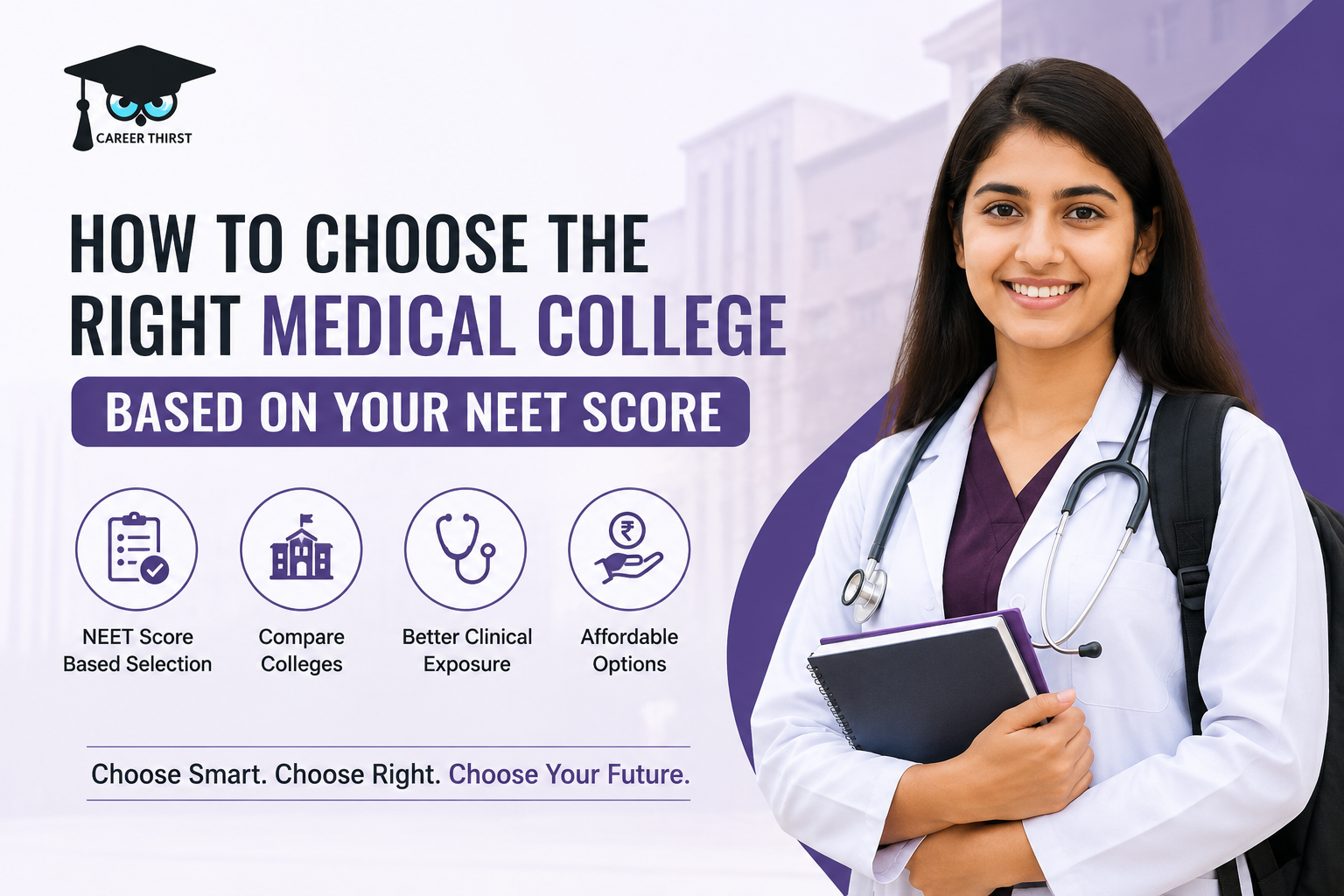
Getting a good NEET score is a major achievement, but your journey does not end there. The next and equally important step is selecting the right medical college. Every year, thousands of students secure qualifying marks in NEET but struggle during the counselling process because they are unsure which college to choose. A rushed decision can lead to higher education costs, limited clinical exposure, or dissatisfaction with the learning environment.
Choosing from the many Medical Colleges in India requires more than looking at rankings or following what others recommend. The right college should align with your NEET score, budget, career aspirations, preferred location, and long-term goals. Whether you are aiming for a government institution or exploring private options, understanding your choices before counselling begins can make the admission process much smoother.
This guide explains how to choose the right medical college based on your NEET score and the factors that truly matter before taking admission.
Why Your NEET Score Should Be the Starting Point
Your NEET score determines the range of colleges you are eligible for during counselling. Instead of searching randomly, start by identifying colleges where your expected rank has a realistic chance of securing admission.
Many students make the mistake of applying only to highly competitive colleges without considering previous years’ closing ranks. Others underestimate their chances and miss better opportunities by filling conservative preferences. Both situations can reduce the likelihood of getting the best possible college.
The smartest approach is to compare your score with previous counselling trends while understanding that cut-offs change every year based on factors such as the number of applicants, exam difficulty, seat availability, and reservation policies.
Rather than asking, “Which is the best college?” ask yourself, “Which is the best college I can realistically get based on my NEET score?” This mindset helps you make practical decisions instead of emotional ones.
Understand the Different Types of Medical Colleges in India
Before selecting a college, it is important to understand the different categories of Medical Colleges in India. Every category offers different advantages, fee structures, and admission processes.
Government medical colleges remain the first preference for most students because they provide quality education at affordable fees. Admission to these colleges is highly competitive, and a strong NEET score is usually required.
Private medical colleges have become a popular choice for students who want access to modern infrastructure, experienced faculty, and good academic facilities. While the tuition fees are generally higher, several private institutions provide excellent medical education and strong clinical exposure.
Deemed universities also offer MBBS programmes and have their own counselling process under the Medical Counselling Committee (MCC). These colleges often attract students from across the country because of their established reputation and wider seat availability.
Understanding these categories helps you create a balanced college preference list instead of focusing on only one type of institution.
Do Not Choose a College Based Only on Rankings
Many students search for the best medical colleges in India and assume that choosing the highest-ranked institution is always the right decision. Rankings are helpful, but they should never be the only deciding factor.
A college ranked slightly lower may provide better clinical exposure, experienced faculty, a more supportive academic environment, and lower overall expenses than a higher-ranked institution. Every student’s priorities are different, which is why your final decision should be based on your personal requirements rather than public rankings alone.
Instead of looking only at ranking lists, compare how each college performs in areas that directly affect your medical education. A well-rounded comparison gives you a much clearer picture of whether a college is the right fit for you.
Compare Colleges Based on Clinical Exposure
One of the biggest differences between medical colleges is the quality of clinical exposure they provide. During your MBBS course, practical learning becomes increasingly important. Students who regularly interact with patients develop stronger diagnostic skills, better communication, and greater confidence.
A teaching hospital with a high patient inflow allows students to observe different medical conditions every day. This practical experience is one of the reasons why many of the top medical colleges in India are highly respected within the medical community.
Before choosing a college, learn about the hospital attached to the institution. A college with modern classrooms but limited patient exposure may not provide the same learning experience as a college with a busy hospital and experienced doctors.
Check Faculty and Academic Environment
Faculty members play a major role in shaping your medical education. Experienced professors bring years of practical knowledge into the classroom and guide students throughout their academic journey.
The best learning environment is one where students are encouraged to ask questions, participate in discussions, and develop critical thinking skills instead of relying only on textbooks. Medical education is constantly evolving, and colleges that promote research, seminars, workshops, and clinical discussions help students stay updated with modern healthcare practices.
When comparing Medical Colleges in India, spend time understanding the academic culture of each institution instead of focusing only on infrastructure.
Research Previous Year’s Cut-Off Trends
Previous years’ closing ranks provide valuable insights into your admission possibilities. While no cut-off remains the same every year, historical data helps students estimate which colleges fall within their expected range.
Instead of selecting colleges blindly, prepare three separate categories.
The first category should include ambitious colleges where admission is possible if the cut-off decreases slightly.
The second category should contain realistic options where your NEET score comfortably falls within the previous admission range.
The third category should include safe choices that increase your chances of securing a seat if competition becomes tougher than expected.
This balanced strategy significantly improves your counselling outcome and reduces unnecessary stress during seat allotment.
Think Beyond MBBS
Choosing a medical college is not only about the next five and a half years. It is also about the opportunities available after graduation.
Many students eventually prepare for postgraduate entrance examinations, research careers, government jobs, or international licensing exams. Colleges that provide strong academic support, research opportunities, experienced mentors, and excellent internship programmes often help students perform better after MBBS.
When evaluating the best medical colleges in India, think about where you want your career to be ten years from now rather than only where you will study next year.
Government vs Private Medical Colleges: Which One Should You Choose?
One of the biggest questions students face during MBBS counselling is whether to choose a government medical college or a private medical college. The answer depends on your NEET score, financial situation, career goals, and the options available during counselling.
Government colleges remain the preferred choice because they offer quality education at a much lower cost. Students also benefit from excellent clinical exposure as most government hospitals handle a large number of patients every day. This allows MBBS students to gain practical experience from the early years of their course.
However, securing admission to a government college is highly competitive. Even students with good NEET scores may miss a government seat due to limited availability and high cut-offs.
Private colleges provide another excellent opportunity for students who may not secure a government seat. Many reputed private institutions have experienced faculty, advanced laboratories, modern classrooms, well-equipped hospitals, and a strong academic environment. While the tuition fees are significantly higher, several private institutions are recognised among the top medical colleges in India because of the quality of education they provide.
Instead of deciding based on the type of institution alone, compare the facilities, hospital exposure, faculty, infrastructure, internship programme, and overall academic environment. A reputed private college can often provide a better learning experience than a lower-ranked government institution.
Factors You Should Compare Before Finalising a Medical College
Choosing from the many Medical Colleges in India requires detailed research. Every college has its own strengths, and students should compare multiple aspects before filling their counselling choices.
The first factor is clinical exposure. Medical education is built around patient care, and colleges with busy teaching hospitals provide students with better opportunities to observe and learn from real medical cases.
Faculty experience is equally important. Professors with years of clinical practice and teaching experience can help students build a stronger foundation in medicine. They also guide students in research, case discussions, and postgraduate preparation.
Infrastructure should never be overlooked. Modern laboratories, digital classrooms, simulation centres, libraries, hostel facilities, and student support services contribute to a better learning experience.
Students should also understand the internship programme offered by the college. A structured internship with exposure to different medical departments prepares students for independent medical practice and future specialisation.
Another important consideration is location. Studying in a city with good healthcare facilities and better connectivity often provides additional learning opportunities through seminars, conferences, and workshops.
When comparing the best medical colleges in India, look beyond promotional brochures and verify information through official websites, counselling authorities, and reliable education experts.
Understanding the Counselling Process
Many deserving students fail to secure admission because they do not fully understand how medical counselling works. The counselling process is more than simply filling college names in a preference list.
After the NEET results are announced, students participate in counselling based on their eligibility. During this stage, colleges should be selected carefully according to your expected admission chances, reservation category, domicile rules, and financial planning.
The order of your preferences is extremely important. A poorly planned preference list may result in missing better colleges that were realistically achievable based on your score.
Students should also keep track of every counselling round, document verification schedule, fee payment deadline, and reporting date. Missing even one important deadline can result in losing the allotted seat.
Preparing for counselling in advance allows students to make informed decisions without unnecessary pressure.
Common Mistakes Students Make During MBBS Admission
Every year, many students lose good admission opportunities because of avoidable mistakes.
One of the most common mistakes is choosing colleges without analysing previous years’ closing ranks. Students often select only dream colleges while ignoring realistic options that match their NEET score.
Another mistake is comparing colleges only on the basis of rankings. Rankings provide useful information, but they do not reflect every aspect of medical education. A college with better patient exposure, experienced faculty, and excellent internship opportunities may offer greater value than a slightly higher-ranked institution.
Financial planning is another area where students make errors. Some families focus only on annual tuition fees without calculating the complete cost of the MBBS programme, including accommodation, books, examination charges, and living expenses.
Many students also ignore the importance of NMC recognition. Before taking admission, always verify that the institution is recognised and approved to offer the MBBS programme.
Finally, students often delay their research until counselling begins. This creates unnecessary confusion because there is very little time to compare colleges once the counselling process starts.
Why Professional Admission Guidance Makes a Difference
Medical admission is one of the most competitive admission processes in India. Every counselling decision can influence your academic journey and future career.
Professional guidance helps students understand their admission possibilities based on their NEET score instead of relying on assumptions. It also helps them compare colleges objectively, understand fee structures, prepare documentation, and develop a counselling strategy that improves their chances of securing a suitable seat.
Students who seek expert guidance usually enter counselling with greater confidence because they already know which colleges fit their profile.
Rather than making emotional decisions under pressure, they follow a structured admission plan designed specifically for their score and career goals.
How Career Thirst Helps You Choose the Right Medical College
Choosing among hundreds of Medical Colleges in India can feel overwhelming without proper guidance. Every student has different academic performance, financial circumstances, career aspirations, and preferred locations. A one-size-fits-all recommendation rarely leads to the best outcome.
At Career Thirst, we believe every student deserves personalised admission guidance. Instead of simply providing a list of colleges, we analyse your NEET score, compare previous admission trends, evaluate your eligibility, and help you create a realistic college preference list.
Our counselling experts assist students throughout the admission journey, from understanding counselling procedures to selecting suitable colleges and completing documentation. We focus on helping students secure admission in colleges that match both their academic profile and long-term career goals.
Whether you are aiming for one of the best medical colleges in India or looking for the right private or government institution within your score range, our team provides practical guidance that helps you make confident admission decisions.
Choosing the right medical college is one of the most important investments in your future. With the right support and proper planning, you can begin your medical career with confidence and clarity.
Frequently Asked Questions
How do I choose the right medical college based on my NEET score?
The first step is to compare your NEET score with the previous year’s closing ranks for different colleges. Once you know the colleges you are likely to get, compare them based on clinical exposure, faculty, infrastructure, internship opportunities, fee structure, location, and hospital facilities. Instead of choosing a college only because of its ranking, select one that matches your academic profile and long-term career goals.
Which are the best medical colleges in India for MBBS?
Some of the best medical colleges in India include AIIMS New Delhi, Christian Medical College (CMC) Vellore, JIPMER Puducherry, King George’s Medical University (KGMU), Maulana Azad Medical College (MAMC), Banaras Hindu University (IMS-BHU), and several reputed government and private institutions. The right choice depends on your NEET score, counselling rank, and personal preferences.
Are government medical colleges better than private medical colleges?
Government medical colleges are generally preferred because of their affordable fees and excellent patient exposure. However, many private institutions also offer quality education, experienced faculty, modern infrastructure, and strong clinical training. The better option depends on your budget, admission opportunities, and career objectives.
What factors should I compare before selecting a medical college?
Students should compare the quality of teaching, hospital facilities, patient inflow, internship programme, faculty experience, hostel facilities, campus environment, infrastructure, tuition fees, location, and NMC recognition. Evaluating these factors helps you choose the right institution from the many Medical Colleges in India.
Is college ranking the most important factor during admission?
No. Rankings provide useful information, but they should not be the only deciding factor. A college with better clinical exposure, experienced faculty, and a strong academic environment may provide a better learning experience than a higher-ranked institution.
How many medical colleges are there in India?
India has more than 700 recognised medical colleges offering MBBS programmes through government, private, deemed, and central institutions. The number continues to increase as new colleges receive approval from the National Medical Commission (NMC).
Is NEET compulsory for admission to medical colleges in India?
Yes. NEET-UG is mandatory for admission to MBBS courses in all recognised Medical Colleges in India. Without qualifying NEET, students cannot participate in the counselling process for MBBS admission.
How can I improve my chances of getting a good medical college?
Planning your counselling strategy is just as important as scoring well in NEET. Research previous years’ cut-offs, prepare a balanced preference list, understand counselling rules, keep your documents ready, and explore both government and private colleges based on your score.
Can I get admission with an average NEET score?
Yes. Every year, many students secure admission through All India Quota, State Quota, deemed universities, and private colleges. The key is choosing realistic college options and participating in every counselling round instead of limiting yourself to only a few institutions.
Why should I take expert admission counselling?
Medical admission involves multiple counselling rounds, changing cut-offs, eligibility rules, documentation, and college comparisons. Expert guidance helps you avoid mistakes, understand your admission opportunities, and select the college that best matches your NEET score, budget, and career goals.
Start Your MBBS Journey with the Right Guidance
Choosing among the many Medical Colleges in India is one of the most important decisions you will make after NEET. A well-informed choice can shape your medical education, improve your clinical learning, and create better career opportunities in the future.
At Career Thirst, we help students shortlist colleges, understand counselling procedures, compare admission options, and make confident decisions based on their NEET score and career aspirations. Whether you are targeting the best medical colleges in India or exploring admission opportunities in the top medical colleges in India, our expert counsellors are here to guide you at every step.
Book your personalised counselling session with Career Thirst today and take the first step towards securing admission to the right medical college for your future.