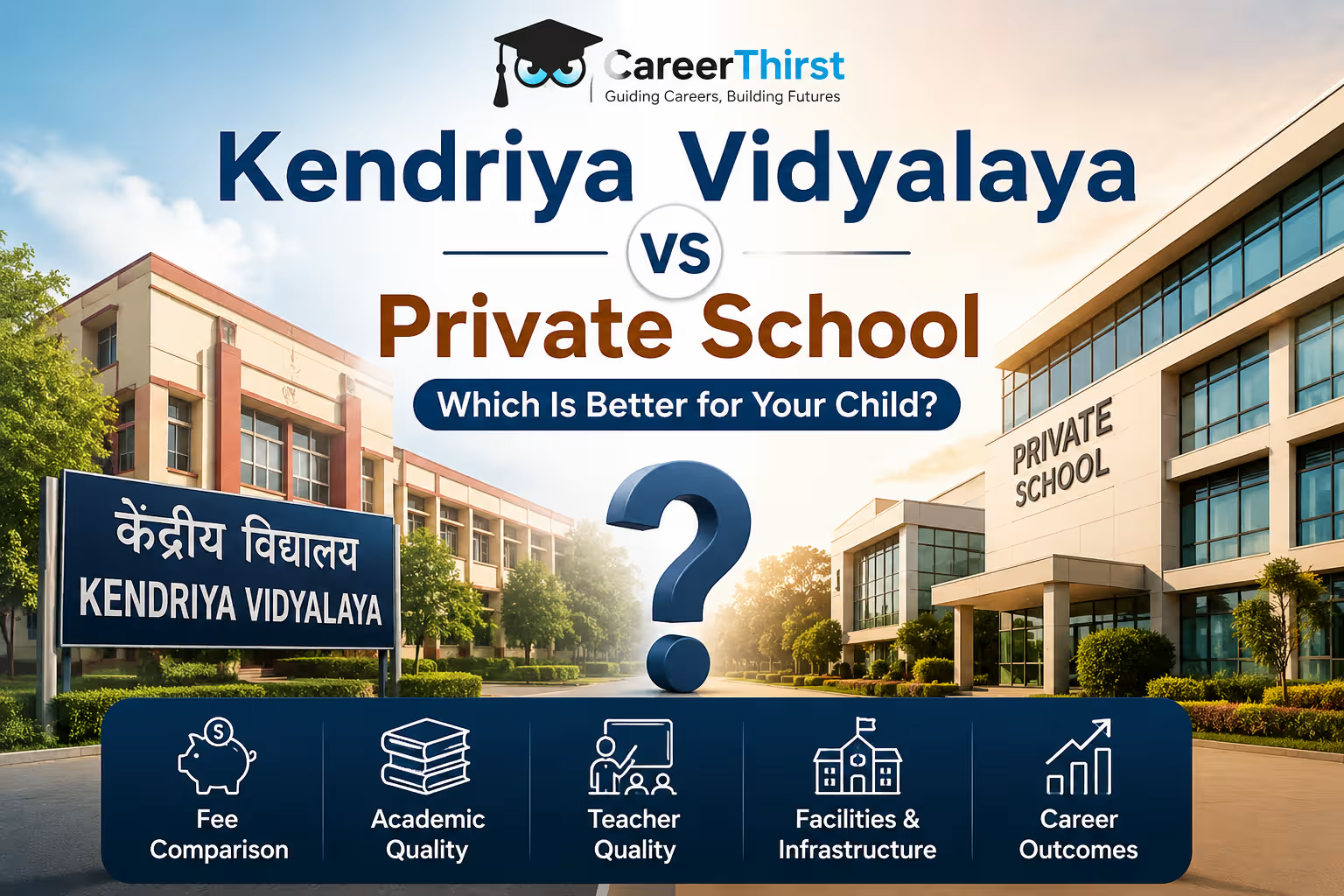
Every year, millions of Indian parents face the same dilemma, should they get their child into a Kendriya Vidyalaya or go for a private school?
Both have strong reputations. Both have real trade-offs. And the answer is not the same for every family.
This guide breaks down the real differences, not just fees and facilities, but actual learning experience, teacher quality, career outcomes , and what day-to-day school life looks like. By the time you finish reading this, you will know which option genuinely fits your child.
What Is Kendriya Vidyalaya and Who Can Get Admission?
Kendriya Vidyalaya (KV) is a network of central government schools run by the Kendriya Vidyalaya Sangathan (KVS) under the Ministry of Education, Government of India. As of 2026, there are over 1,250 KV schools across India, including schools abroad in Indian embassies.
KVs were originally started for children of central government employees who get transferred frequently. The idea was simple: a child should not suffer academically because their parents got posted to a different city. Every KV follows the same curriculum, same calendar, and same academic structure, so transferring from Lucknow to Bangalore does not set a child back.
Who Can Apply for KV Admission?
Admission priority works in a specific order. Children of central government employees get the highest preference. After them, children of state government employees, defence personnel, and then general public applicants get a chance based on remaining seats. Class 1 admissions are done through a computerized lottery system. There is no entrance exam for primary classes.
What Are Private Schools in India?
Private schools in India are independently managed institutions run by trusts, societies, or private bodies. They follow different boards, CBSE, ICSE, IB (International Baccalaureate), IGCSE, and set their own fee structure, teaching methods, and rules.
The quality of private schools varies enormously. A top-tier private school in Delhi or Mumbai offers world-class infrastructure and experienced faculty. A mid-range private school in a Tier-2 city may offer little more than a KV at three times the cost.
Kendriya Vidyalaya vs Private School: The Real Comparison
1. Fee Structure
This is where KV wins without any debate.
KV charges one of the lowest fee structures among recognized schools in India. Boys from Class 3 onwards pay a tuition fee of just ₹500 per month. Girls and SC/ST students are completely exempt from tuition fees. The total annual cost of studying in a KV, including all charges, typically stays between ₹5,000 to ₹15,000 per year.
Private schools tell a very different story. Decent CBSE private schools in Tier-1 cities charge anywhere between ₹60,000 to ₹3,00,000 per year. ICSE and IB schools can go even higher. Add admission fees, development charges, annual fees, books, uniforms, and school trips, the actual cost runs into lakhs for many families.
Verdict: If affordability is a concern, Kendriya Vidyalaya is not even a comparison. It is a clear winner.
2. Academic Quality and Board Affiliation
All KV schools are affiliated with CBSE. The syllabus is centrally designed and consistent across all 1,250+ schools. This makes it easy to compare performance and ensures every child gets the same standard of education whether they study in Shimla or Chennai.
Private schools follow different boards. CBSE private schools offer the same curriculum as KV but with more resources. ICSE schools go slightly deeper into Science and English. IB schools follow an internationally recognized curriculum better suited for children aiming to study abroad.
KV students consistently perform well in CBSE board exams. The pass percentage and average scores in KV schools have historically been higher than the national average for CBSE schools. This is a fact, not a claim.
Verdict: For CBSE standard education, KV matches or outperforms most private schools of similar standing. For international curriculum or board flexibility, private schools have the edge.
3. Teacher Quality
KV teachers go through a rigorous government recruitment process. PGT (Post Graduate Teachers), TGT (Trained Graduate Teachers), and PRT (Primary Teachers) are selected through KVS examinations, one of the most competitive teacher recruitment processes in India. Once recruited, they undergo regular training through KVS-run programs.
The key issue with private schools is inconsistency. Top private schools recruit experienced faculty and pay competitive salaries. Many mid-range private schools, however, hire underqualified teachers at low salaries to keep costs down, and turnover is high.
One genuine concern in KV is teacher transfers. A good teacher may get transferred mid-year, which disrupts learning for students who have built a comfort level with that teacher.
Verdict: KV teacher quality is reliable and government-tested. Private school teacher quality depends entirely on which school you are comparing.
4. Infrastructure and Facilities
This is where private schools, especially premium ones, pull ahead.
Most KVs have standard infrastructure, classrooms, science labs, computer labs, libraries, and playgrounds. Many KV schools, especially those on defence campuses or IIT/IIM premises, have large green campuses that most private schools cannot match. KV schools under the PM SHRI scheme are being upgraded with smart classrooms and better digital infrastructure.
High-end private schools offer swimming pools, air-conditioned classrooms, dedicated arts and music studios, multiple sports courts, and international-standard science labs. They invest heavily in infrastructure because it is a selling point for fee-paying parents.
Verdict: Premium private schools win on infrastructure and facilities. KVs are adequate and improving, but not at the same level as top private institutions.
5. Extracurricular Activities
This is an area where KV surprises many parents.
KV schools actively push students to participate in sports, cultural events, science fairs, and national competitions. NCC (National Cadet Corps), NSS, Scouts and Guides, these are integral parts of KV school life. Students are actively encouraged to represent their school and region at state and national levels.
Many private schools, especially mid-range ones, treat extracurriculars as optional add-ons. There are coaching sessions for specific activities, but participation is often not encouraged at the same community scale as KV.
Verdict: KV schools offer broader and more inclusive extracurricular opportunities. Students are given a platform regardless of their background.
6. Discipline and School Culture
KV follows a uniform national culture across all schools, same uniform style, same morning assembly format, same national value-based approach. There is a strong emphasis on discipline, respect for teachers, and national pride. Students from different states, religions, and backgrounds study together, which builds a naturally inclusive mindset.
Private school culture varies widely. Premium schools focus on confidence-building, public speaking, and creativity. But some private schools have a strict environment that can suppress a child’s individuality. Others are too lax and lack the structure that helps a child develop routine and discipline.
Verdict: KV has a consistent, nationally grounded school culture. Private schools vary too much to generalize.
7. Transfer Flexibility
This is one of KV’s strongest practical advantages, and it is often overlooked.
If a parent gets transferred from Pune to Chandigarh, their child can seamlessly move from one KV to another. Same syllabus, same academic calendar, same assessment pattern. The child does not lose a term or fall behind.
In private schools, mid-year transfers are painful. Different boards, different syllabus pacing, different grading systems, a child moving cities may end up either repeating topics or missing chapters entirely.
Verdict: For families with transferable jobs, Kendriya Vidyalaya has no competition in this regard.
8. Career Outcomes and College Admissions
There is a perception that private school students do better in college admissions. The reality is more nuanced.
KV students perform strongly in engineering and medical entrance exams. Many IIT and AIIMS toppers have come from KV schools. The CBSE curriculum followed in KV is the same that forms the base for JEE and NEET preparation. Students from KV schools are not at a disadvantage in any competitive exam.
For students aiming for international universities or IB-based programmes, private schools with IB or IGCSE boards offer a more relevant preparation pathway.
Verdict: For domestic competitive exams and Indian university admissions, KV students compete equally. For international pathways, certain private schools are better positioned.
Head-to-Head Summary Table
Parameter | Kendriya Vidyalaya | Private School |
Annual Fees | ₹5,000 – ₹15,000 | ₹60,000 – ₹3,00,000+ |
Board | CBSE only | CBSE, ICSE, IB, IGCSE |
Teacher Quality | Government tested reliable | Varies by school |
Infrastructure | Standard to good | Good to world-class |
Extracurriculars | Broad and inclusive | Varies widely |
Transfer Flexibility | Excellent across India | Very difficult |
Discipline | Consistent national culture | Varies by school |
Competitive Exam Prep | Strong | Strong (CBSE schools) |
International Pathway | Limited | Strong (IB/IGCSE schools) |
So Which One Should You Choose?
Choose Kendriya Vidyalaya if:
Your family budget is tight and you want quality education without financial stress. Your job involves frequent transfers across cities. You want your child to be in a disciplined, culturally inclusive environment. You are preparing your child for CBSE-based competitive exams like JEE or NEET.
Choose a Private School if:
You have the financial capacity and want premium infrastructure. Your child has specific interests like international sports, arts, or foreign-language programs that only certain private schools offer. You are planning to send your child abroad for higher education and want IB or IGCSE exposure from early on.
Conclusion
Kendriya Vidyalaya is not a compromise. It is a genuinely good school system that has produced engineers, doctors, IAS officers, and researchers in large numbers. The low cost does not reflect low quality, it reflects government subsidy with a clear purpose.
Private schools are not automatically superior. Many of them charge five times more and deliver three times less than what families expect.
The right choice depends on your child’s needs, your financial situation, and your long-term goals for their education. Both systems have produced outstanding students. Do not let labels decide, let the actual comparison guide you.
Frequently Asked Questions (Kendriya Vidhalya Admission 2026-27)
Can a private sector employee's child get admission in Kendriya Vidyalaya?
Yes, but the chances are low. KV gives first preference to children of central government and defence employees. Private sector employees come last in the priority list. Admission is only possible if seats are left after all other categories are filled. Your chances are better in smaller cities than in metro cities.
What is the age limit for Kendriya Vidyalaya Class 1 admission in 2026-27?
Your child must be minimum 6 years and maximum 8 years old as of 31st March 2026. No age relaxation is given except for differently-abled children, who can get up to 2 years of relaxation. Children born on 1st April are also considered eligible.
Is there any entrance exam for Kendriya Vidyalaya admission in 2026?
For Class 1 to 8 (No exam) Selection is done through a lottery system. For Class 9 ( Yes, a written test is held covering Maths, Science, English, Hindi, and Social Science). Minimum passing score is 33%. For Class 11 (No exam). Admission is based on Class 10 board marks.
What documents are required for KV admission 2026-27?
Keep these documents ready before you apply:
Child’s birth certificate (issued by a government authority) Passport-size photograph of the child Parent’s Aadhaar card or any government ID Proof of residence (Aadhaar, utility bill, or rent agreement) Service certificate from employer (for government employees) Caste certificate (for SC, ST, or OBC students) Transfer certificate from previous school (for Class 2 and above)
How does the KVS lottery system work for Class 1 admission?
When more parents apply than seats available, KVS picks students through a computerized lucky draw. The draw happens separately for each category — government employees in one group, general public in another. Every school forms a 5-member committee to conduct the draw fairly. No school staff can influence the result.
How many Kendriya Vidyalaya schools can I apply to in one application?
You can choose up to 3 KV schools in one application. Always select all 3 — if your child is not selected in the first school, the application automatically moves to the second and third choice. Selecting only one school reduces your child’s chances significantly.
When will KVS admission 2026-27 open for the next academic session?
For 2026-27, Class 1 registration opened on 20th March 2026. For 2027-28, expect a similar schedule, notification in February, Class 1 online registration in mid-March, and offline admissions for other classes in April. Class 11 admissions open after CBSE Class 10 results in May or June. Keep checking kvsangathan.nic.in for exact dates.
Is Kendriya Vidyalaya only for government employees or can anyone apply?
Anyone can apply. KV is not restricted to government employees. The difference is only in priority, government and defence employees get seats first. If seats are left after them, private sector employees and general public parents can get admission. The application is free, so there is no harm in trying.
Can I transfer my child from one Kendriya Vidyalaya to another KV in a different city?
Yes. If a parent gets a job transfer, their child gets admission in the nearest KV of the new city without waiting for a vacancy. You just need the child’s transfer certificate from the current KV and the parent’s official transfer order. Since all KVs follow the same syllabus, the child does not fall behind in studies.
How much are the actual fees at Kendriya Vidyalaya?
KV fees are very low compared to any private school. There is no big admission fee, no hidden charges. Here is everything broken down simply:
Tuition Fee (Monthly) :
Who | Class | Monthly Fee |
All Girls | Class 1 to 12 | Free (No fee at all) |
SC / ST Students | Class 1 to 12 | Free (No fee at all) |
Boys | Class 1 to 8 | Free (No fee at all) |
Boys | Class 9 and 10 | Rs. 200 per month |
Boys | Class 11 and 12 (Science or Commerce) | Rs. 300 per month |
Boys | Class 11 and 12 (Humanities) | Rs. 100 per month |
Other Small Charges (Same for Everyone):
Charge | Amount |
Computer Fund | Rs. 100 per month (from Class 3 onwards) |
School Development Fund | Rs. 500 per year (one time, annually) |
RTE Quota Students (Pay Absolutely Nothing. Zero fees, zero charges)
Real Example for a Parent:
If your son is in Class 9, he pays Rs. 200 tuition + Rs. 100 computer fund = Rs. 300 per month. That is Rs. 3,600 per year plus Rs. 500 VVN = roughly Rs. 4,100 total for the full year.
A comparable private school charges Rs. 60,000 to Rs. 1,50,000 for the same year.